
In the span of roughly eighteen months, a series of digital files changed hands for prices that rival Picasso, Rembrandt, and Basquiat. No physical canvas was exchanged. No gallery required a visit. A few keystrokes, a blockchain transaction, and suddenly, a JPEG or a conceptual artwork was worth tens of millions of dollars.
The rise of NFTs — non-fungible tokens forced collectors, institutions, and the wider public to fundamentally reconsider what makes something valuable. The answer, it turned out, had everything to do with provenance, scarcity, and community belief. The same principles that have underpinned fine art for centuries, now encoded on a decentralized ledger.
This article breaks down the most expensive NFTs ever sold, ranked by sale price, with full context on the artist, the buyer, the sale, and what it meant for the NFT world. We also cover the five key factors that drive NFT value, the collections behind the biggest sales, and a frank assessment of where the market stands.
The 10 Most Expensive NFT Sales in History
| Rank | NFT | Sale Price | Date |
| #1 | The Merge | $91.8M | Dec 2021 |
| #2 | Everydays: The First 5000 Days | $69.3M | Mar 2021 |
| #3 | Clock | $52.7M | Feb 2022 |
| #4 | HUMAN ONE | $28.9M | Nov 2021 |
| #5 | CryptoPunk #5822 | $23.7M | Feb 2022 |
| #6 | CryptoPunk #7523 | $11.8M | Jun 2021 |
| #7 | CryptoPunk #1563 | $12.1M | Oct 2025 |
| #8 | TPunk #3442 | $10.5M | Aug 2021 |
| #9 | CryptoPunk #4156 | $10.2M | Dec 2021 |
| #10 | Ocean Front | $6M | Mar 2021 |
Note: Sale prices are recorded in USD at the time of sale. Crypto-denominated sales have been converted using the exchange rate at the point of transaction. Prices are not adjusted for inflation.
The Most Expensive NFTs Ever Sold: Full Deep Dives
1. The Merge by Pak — $91.8 Million | December 2021
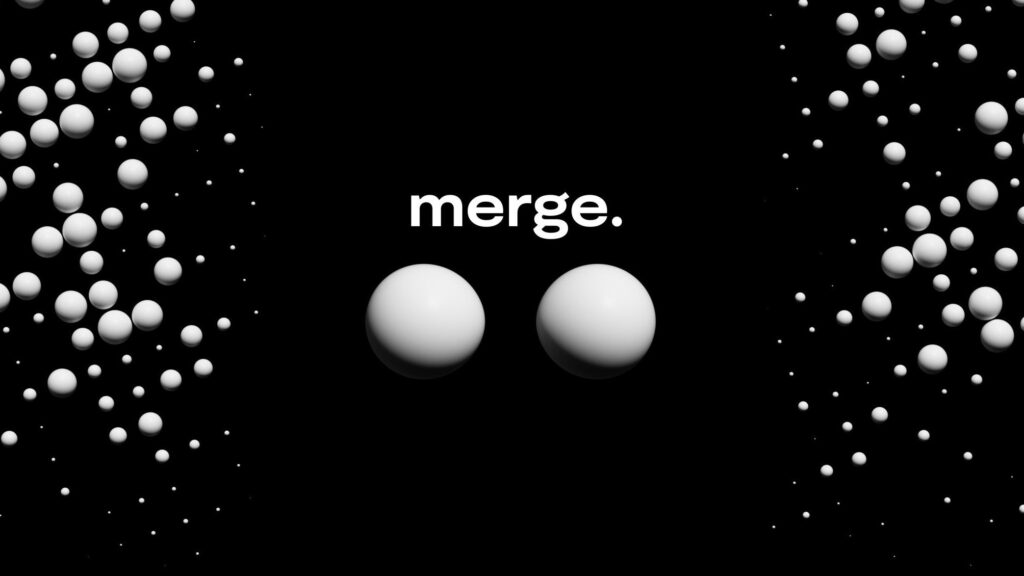
No NFT in history has generated more money than The Merge. The way it was sold was unlike anything that had come before it, and that distinction matters.
On December 2, 2021, the anonymous digital artist known as Pak launched a 48-hour open edition sale on Nifty Gateway. Instead of selling a single artwork to a single buyer, Pak sold the piece in units called “mass.” Any collector could buy as many units as they wanted, at $575 per mass on day one, rising by $25 each subsequent day.
The more mass a collector acquired, the larger their personal NFT fragment would grow. When two collectors merged their holdings, the smaller token was absorbed into the larger and destroyed in the process. The total supply was therefore deflationary by design.
When the 48 hours were up, 28,983 collectors had collectively purchased 312,686 mass units for a combined total of $91.8 million. That figure surpassed Jeff Koons’ Rabbit sculpture, which sold for $91.1 million in 2019. Thus making The Merge the highest-grossing work ever sold by a living artist at the time.
The identity of Pak remains one of digital art’s great mysteries. Some believe Pak is a single individual, possibly Turkish digital artist Murat Pak. Others speculate it is a collective or even an AI system. Pak has never confirmed their identity, and the anonymity itself has become part of the mystique and the brand.
2. Everydays: The First 5000 Days by Beeple — $69.3 Million | March 2021
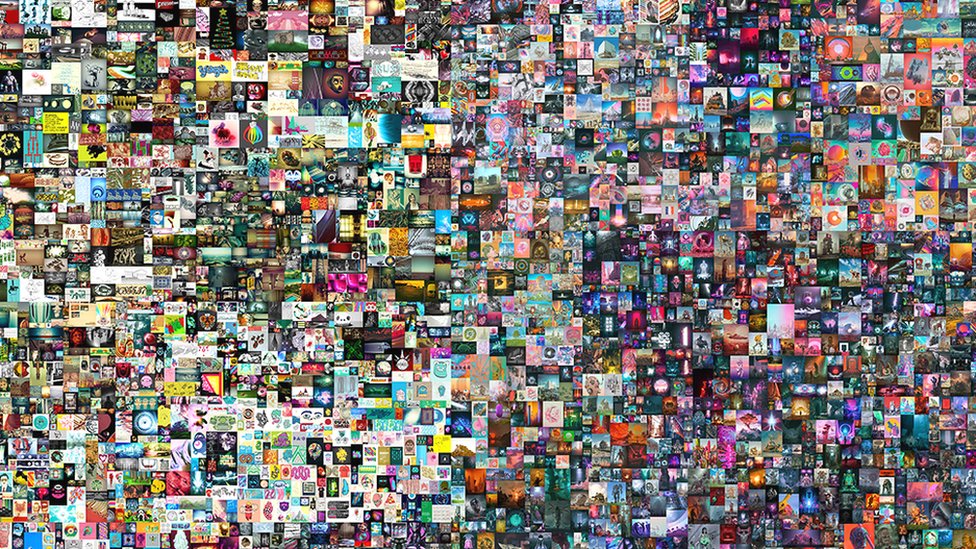
If The Merge redefined the mechanics of how NFTs are sold, Everydays: The First 5000 Days by Beeple redefined who would take NFTs seriously. This was the auction that brought Christie’s. Founded in 1766 into the blockchain age.
The story behind the artwork begins in May 2007, when Mike Winkelmann, a graphic designer from Charleston, South Carolina, made a commitment: he would create and publish one piece of digital art every single day without exception. He called the project Everydays. For the next 13 years and 138 days, he honoured that commitment. The result was 5,000 images charting his evolution as an artist, his observations on culture and politics, and his descent into increasingly surreal, dystopian, and thought-provoking digital worlds.
In March 2021, Christie’s offered the complete collage of all 5,000 images as a single NFT. The auction house’s first purely digital artwork. Bidding opened at $100. What followed over 14 days was a feeding frenzy. The winning bid came from Vignesh Sundaresan, a Singapore-based crypto entrepreneur who goes by the alias MetaKovan, who paid $69.3 million in Ether.
“The point was to show Indians and people of color that they, too, could be patrons,” Sundaresan later explained, describing his motivation as partly personal and partly political. A demonstration that the crypto economy was redistributing access to cultural capital beyond Western institutions.
The Everydays sale remains the single most important transaction in NFT history from a cultural standpoint.
3. Clock by Pak & Julian Assange — $52.7 Million | February 2022
Clock is, visually, almost aggressively simple. A counter on a black background, incrementing one digit every day. The number it displays is the count of days that WikiLeaks founder Julian Assange has been in custody.
The concept is stark, the execution minimal, and the message unmistakable. Clock was a collaboration between Pak and Assange himself, conceived as a fundraising mechanism for Assange’s legal defence against extradition to the United States.
To purchase the work, supporters formed AssangeDAO. A decentralized autonomous organization in which more than 10,000 individual contributors pooled cryptocurrency. In February 2022, AssangeDAO completed the purchase for $52.7 million. Every dollar went to Assange’s legal team.
Clock holds a unique place on this list because its value was explicitly political and communal rather than purely aesthetic or speculative. It is perhaps the clearest example of NFTs functioning as a vehicle for collective action. A new form of crowdfunded advocacy encoded on the blockchain.
4. HUMAN ONE by Beeple — $28.9 Million | November 2021
HUMAN ONE represented a new frontier for Beeple: a work that bridges the digital and physical worlds in the most literal sense. The piece is a monolith, a free-standing aluminium sculpture over seven feet tall, with four LED screens tiled across its surface. On those screens, an endless video plays of a lone astronaut in a silver suit, walking through shifting landscapes: a desert at dawn, a midnight cityscape, a forest in winter, an alien terrain.
The twist and what makes HUMAN ONE conceptually distinct from any other NFT on this list is that Beeple retains the right to update the video remotely. The artwork is never finished. It is a living piece that will evolve for as long as Beeple chooses to continue adding to it, and as long as whoever owns it keeps the screens powered.
Sold at Christie’s in November 2021 for $28.9 million (including buyer’s premium), the winning bidder was Ryan Zurrer, a venture partner and crypto investor. The purchase included both the physical sculpture and a corresponding NFT deed of ownership — the two are inseparable.
HUMAN ONE asks a provocative question about the nature of art: can a work be simultaneously complete and in perpetual progress? Beeple has never given a definitive answer. He doesn’t need to.
5. CryptoPunk #5822 — $23.7 Million | February 2022
CryptoPunks was launched by Larva Labs in 2017 as a free experiment in digital scarcity. Ten thousand procedurally generated pixel-art characters, each 24×24 pixels, were made available at no cost to anyone with an Ethereum wallet. At the time, most people ignored them.
By 2021, they had become the status symbols of the crypto-native world, and certain rare variants had become worth millions. CryptoPunk #5822 is among the rarest of all: an “Alien” punk — a type of which only nine exist in the entire collection of ten thousand. It wears a blue bandana, one of only 333 punks with that accessory. The combination of the alien base type and the bandana attribute produces a rarity that collectors prize above almost everything else in the collection.
In February 2022, Deepak Thapliyal, the CEO of blockchain infrastructure company Chain, paid $23.7 million for #5822 making it the most expensive CryptoPunk ever sold. Thapliyal confirmed the purchase publicly on Twitter, cementing his position as one of the most prominent NFT collectors of the era.
6. CryptoPunk #7523 “Covid Alien” — $11.8 Million | June 2021
Another Alien punk — one of only nine — CryptoPunk #7523 acquired its nickname from a single, timely attribute: a medical mask. When it was sold at a Sotheby’s “Natively Digital” auction in June 2021, the world was still in the thick of the COVID-19 pandemic, and the image of an alien wearing a surgical mask felt both absurd and perfectly zeitgeist.
Israeli businessman Shalom Meckenzie paid $11.75 million for the privilege. The punk also wears a knit cap and a single gold earring, but it was the mask that made it famous. An accidental piece of cultural commentary that arrived years before the pandemic, and became relevant for reasons its creators could never have anticipated.
7. CryptoPunk #1563 — $12.09 Million | October 2025 [Most Recent Blue-Chip Sale]
The October 2025 sale of CryptoPunk #1563 for approximately $12.09 million (2,740 ETH) was a signal that the market for genuinely rare, historically significant digital assets had not collapsed alongside the thousands of speculative collections that faded after the 2021–2022 peak.
While the majority of NFTs issued during the boom years have lost nearly all their value, the original blue-chip CryptoPunks continue to trade at prices that would be considered exceptional in any art market.
#1563 underscores the flight to quality that has come to define the NFT market in its post-peak maturation phase.
8. TPunk #3442 “Joker Punk” — $10.5 Million | August 2021
TPunks were the Tron blockchain’s answer to CryptoPunks, a collection of 3,999 pixel-art characters on the Tron network. Most traded for a few hundred dollars. TPunk #3442 was the exception: it bore a striking resemblance to the Joker from DC Comics, which made it among the most sought-after in the collection.
Justin Sun, the founder of the Tron blockchain, purchased it for 120 million TRX tokens — equivalent to $10.5 million at the time. Sun immediately donated the NFT to the APENFT Foundation, a project he backed that aimed to tokenize fine art on the blockchain.
Whether the purchase was genuine conviction or a calculated publicity move to boost the Tron NFT ecosystem, it achieved its aim: TPunk #3442 became one of the most-discussed NFT sales of August 2021.
10. Ocean Front by Beeple — $6 Million | March 2021
Ocean Front is a digital artwork depicting a tree perched atop a precarious stack of shipping containers and vehicles rising above a rising ocean. Beeple’s commentary on climate change and environmental fragility.
Sold in March 2021 for exactly $6 million, Beeple donated the entire proceeds to the Open Earth Foundation, a non-profit tracking progress on the Paris Agreement.
Ocean Front closes the top ten with a reminder that NFT sales, at their most purposeful, can mobilise significant capital toward causes that matter and that artists retain the power to determine what their record-breaking work is worth beyond the ledger.
What Makes an NFT Expensive? The 5 Core Value Drivers
Understanding why these NFTs commanded eight-figure prices requires a framework. The value of any asset is ultimately determined by supply and demand but for NFTs, five specific forces interact to produce the conditions for record-breaking prices.
1. Verified Digital Scarcity
Unlike a digital image that can be copied an infinite number of times, an NFT’s ownership record is cryptographically enforced on a blockchain. There can only ever be one verified owner of a given token.
The Alien CryptoPunks are scarce not because someone says so, but because the smart contract governing the collection makes it mathematically impossible to produce a ninth Alien punk. This immutable scarcity is the foundation on which all NFT value is built.
2. Creator Reputation and Cultural Capital
Beeple did not become worth $69 million overnight. He spent 13 years building a following, a style, and a body of work that made Everydays legible as important art to a global audience.
Similarly, Pak’s years of cryptic conceptual releases built a reputation that made The Merge’s unconventional structure feel visionary rather than confusing. In NFTs as in traditional fine art, the creator’s name functions as a multiplier on the underlying asset value.
3. Auction House Legitimacy
When Christie’s, a 258-year-old institution synonymous with the highest tiers of art commerce; accepted Everydays as a work worthy of its main sale room, it sent a signal to every institutional collector, hedge fund, and museum in the world: this is real.
The Christie’s and Sotheby’s imprimatur converted NFTs from crypto-native speculation into credible fine art assets, opening the market to a completely new class of buyer.
4. Community and On-Chain Status Signalling
A CryptoPunk is not just a pixelated image. In the crypto-native communities of 2021 and 2022, setting one as your Twitter profile picture was a declaration of identity, wealth, and belonging. The social currency of CryptoPunk ownership was real and measurable.
The premium paid for the rarest punks reflected not just their aesthetic rarity, but the status conferred by owning them publicly on-chain. This dynamic NFTs as status objects, amplified prices far beyond what pure aesthetic value could justify.
5. Utility, Innovation, and Smart Contract Mechanics
The Merge would not have sold for $91.8 million if it had simply been a static image. Its deflationary mechanics, its live evolution, and its unprecedented collective-ownership structure created a genuinely new kind of asset class.
HUMAN ONE’s perpetual updatability gave its owner something no physical artwork can offer: a living relationship with the artist, encoded contractually. NFTs that push beyond the JPEG paradigm introducing programmable utility, evolving attributes, or novel sale structures. Also, consistently command premium prices because they are, quite literally, unprecedented.
The Collections and Artists Behind the Biggest Sales
CryptoPunks — The Original Blue-Chip NFT Collection
CryptoPunks, created by Matt Hall and John Watkinson at Larva Labs in June 2017, is widely credited as the first NFT collection on the Ethereum blockchain. The 10,000 characters grouped by type (Human, Zombie, Ape, Alien) and adorned with up to seven randomized attributes were made available for free to anyone with a wallet. Most were claimed. Most were ignored. A handful became the most valuable digital collectibles in history.
Five of the top ten most expensive individual NFT sales are CryptoPunks. The collection’s intellectual property was acquired by Yuga Labs. The creators of the Bored Ape Yacht Club in March 2022, further cementing the cultural legitimacy of the brand. As of 2025, the CryptoPunks floor price has declined significantly from its 2021 peak, but the rarest variants. Aliens in particular continue to command prices in the millions, as evidenced by the $12.09 million sale of #1563 in October 2025.
Beeple — The Artist Who Put NFTs in the Pages of History
Mike Winkelmann, known professionally as Beeple, holds three of the top ten spots on this list and remains the most culturally significant individual artist in NFT history. His 13-year Everydays project — completed before NFTs existed as a commercial phenomenon. This gave him a body of work with genuine historical depth. When Christie’s offered the complete Everydays collection as a single NFT, the narrative was already written: an artist who had shown up every single day for thirteen years was getting his due.
Beyond Everydays, Beeple has continued to push the boundaries of digital and physical art with HUMAN ONE, releasing new NFT works and remaining one of the most closely followed artists in the space. His willingness to donate the $6 million Ocean Front proceeds to climate charity also demonstrated that NFT wealth could be put to purposeful use.
Pak — The Anonymous Visionary
Pak is perhaps the most intriguing figure in NFT art. Operating under a pseudonym for decades — first in the world of digital design, later in crypto art — Pak’s identity remains unconfirmed. What is confirmed: their work consistently challenges the assumptions of what art, ownership, and value mean in a digital context.
The Merge was not just a record-breaking sale; it was a philosophical statement about collective ownership, scarcity by design, and the relationship between artist and community. Clock was not just a timer; it was a political instrument encoded on-chain. Pak’s influence on the NFT art world extends far beyond the dollar figures next to their name.
The NFT Market in 2026: Where Do Things Stand?
Honesty is important here. The NFT market of 2026 looks very different from the fever of 2021.
Total NFT transaction volume dropped to approximately $5.5 billion in 2025, a roughly 37% decline from 2024, and a fraction of the $25+ billion generated at the market’s 2021 peak. The overall NFT market capitalisation shrank from around $9 billion to approximately $2.4 billion by late 2025. Approximately 96% of NFT collections issued during the boom years now have no measurable trading activity or community engagement.
The major platforms have pivoted. OpenSea once the dominant marketplace shifted its focus toward token trading. Zora abandoned the traditional NFT model entirely, moving to a “content as tokens” framework. NFT Paris, once the flagship industry event, was cancelled in 2025 due to insufficient funds.
New categories are emerging. Gaming NFTs now account for roughly 25–38% of total NFT transaction volume. Real-world asset tokenization, representing fractional ownership of property, art, and intellectual property as NFTs is growing rapidly. Intelligent NFTs, combining blockchain provenance with AI adaptability, represent approximately 30% of new project development in 2025.
Snoop Dogg’s collaboration with the TON blockchain and Telegram in July 2025, which raised $12 million in under 30 minutes, signaled that NFTs are evolving from speculative art assets into functional social objects embedded in daily digital communication.
The NFT market is consolidating around genuine utility and demonstrable scarcity. The projects that survive and appreciate are those with real communities, real use cases, or irreplaceable historical significance. The speculative froth has cleared. What remains is real.
Frequently Asked Questions
What is the most expensive NFT ever sold?
The most expensive NFT ever sold by total value is The Merge by Pak, which generated $91.8 million through a collective sale involving nearly 29,000 buyers in December 2021. The most expensive single-buyer NFT sale is Everydays: The First 5000 Days by Beeple, purchased by Vignesh Sundaresan for $69.3 million at Christie’s in March 2021.
Who bought the most expensive NFT?
The most expensive single-buyer NFT Everydays: The First 5000 Days was purchased by Vignesh Sundaresan, a crypto entrepreneur also known as MetaKovan. The Merge was collectively purchased by nearly 29,000 buyers, so it has no single owner in the traditional sense.
What is Beeple’s most expensive NFT?
Beeple’s most expensive NFT is Everydays: The First 5000 Days, which sold for $69.3 million in March 2021 at Christie’s. His second most expensive is HUMAN ONE, a physical-digital hybrid sculpture that sold for $28.9 million in November 2021, also at Christie’s.
What is the most expensive CryptoPunk NFT ever sold?
The most expensive CryptoPunk ever sold is CryptoPunk #5822, which sold for $23.7 million in February 2022. It is one of only nine Alien-type punks in the 10,000-piece collection, and it features an ultra-rare blue bandana. CryptoPunk #1563 was the most expensive NFT sale of 2025, fetching $12.09 million in October 2025.
Are the most expensive NFTs still worth the same amount today?
No. The majority of the NFTs on this list were sold at or near the peak of the 2021–2022 NFT market and would not fetch the same prices today. The market contracted significantly from 2022 onward. However, the rarest CryptoPunks and works by Beeple and Pak have retained more of their value than most NFTs, and continue to trade for millions of dollars in private transactions.
What was the most expensive NFT sold in 2025?
The highest-dollar NFT sale verified in 2025 was CryptoPunk #1563, which sold for approximately $12.09 million (2,740 ETH) in October 2025. The highest ETH-denominated sale of 2025 was CryptoPunk #3100, which sold for 4,200 ETH (approximately $6.6 million at the time) in April 2025.
How did traditional auction houses like Christie’s get involved in NFTs?
Christie’s entered the NFT market in March 2021 with the sale of Everydays: The First 5000 Days, making it the first major auction house to sell a purely digital NFT artwork. The move was both a commercial decision and a cultural signal: by accepting a digital file in its main sale room, Christie’s conferred institutional legitimacy on NFTs as an asset class. Sotheby’s followed shortly after with its own NFT sales, including the sale of CryptoPunk #7523 for $11.8 million in June 2021.
Can I buy a share of the most expensive NFTs?
In most cases, no — the NFTs on this list are held by single owners or, in the case of The Merge, by thousands of holders of distinct mass units. However, the principle of fractional NFT ownership does exist: some platforms allow NFTs to be split into fungible tokens representing percentage ownership, enabling smaller investors to gain exposure to high-value assets. This is a growing area but remains a niche mechanism in 2026.
Conclusion
The most expensive NFTs ever sold represent more than record-breaking transactions. They are cultural artefacts of a specific moment in digital history: a window of roughly eighteen months when the combination of blockchain technology, pandemic-era liquidity, crypto enthusiasm, and genuine artistic ambition produced a market for digital ownership that the world had never seen.
The Merge proved that digital art could mobilise collective ownership on an unprecedented scale. Everydays proved that sustained creative practice, made visible by technology, could rival the greatest physical artworks in commercial value. The CryptoPunks proved that scarcity, when verifiable and immutable, creates value regardless of the medium.
The market that generated these sales has contracted sharply. But the underlying principle that on-chain verified scarcity, paired with genuine cultural significance and community conviction, can sustain extraordinary value has not been disproven. It has been refined.
The next record-breaking NFT sale will likely require a specific alignment: a major cultural moment, a creator with an established legacy, and a buyer community ready to believe. That combination has happened before. There is no reason it cannot happen again.