


Author
Ahmed Balaha
Author

Share

Foundry Digital’s newly launched Zcash (ZEC) mining pool captured approximately 29% of the network’s total hashrate within a month of going live, a rate of consolidation that rivals what ViaBTC, the prior dominant pool, took considerably longer to establish.
The pool went public in April 2026 after Foundry announced the initiative on March 11, onboarding institutional miners ahead of the public launch.
The speed of that hashrate capture is the signal worth examining. Foundry didn’t inch into Zcash mining, it arrived and immediately held roughly the same share that ViaBTC had built as the incumbent leader, sitting at around 30% of network hashrate before Foundry’s entry.
- Hashrate Capture: Foundry’s Zcash pool seized ~29% of network hashrate within one month of launch, per company data and the new Zcashinfo.com block explorer.
- Zcash Network Context: Zcash’s total hashrate had risen from 8.1 GSol/s to 13.8 GSol/s since early September 2025 before Foundry’s entry, with ViaBTC previously holding ~30% dominance.
- Pool Structure: The pool uses a PPLNS payout model, distributes rewards via transparent ZEC addresses, enforces KYC/AML checks, and requires no minimum hashrate, a deliberate institutional access design.
- Compliance Infrastructure: Foundry’s pool mirrors the SOC 1 Type 2 and SOC 2 Type 2 compliance framework of Foundry USA Pool, its dominant Bitcoin mining operation.
- Zcashinfo.com Launch: Foundry released a dedicated Zcash block explorer alongside the pool, providing real-time hashrate distribution, pool rankings, and mining difficulty tracking.
- What to Watch: Whether Foundry’s share continues climbing past 30% – the threshold at which centralization risk becomes a live network security debate – is the next data point that matters.
Discover: How sovereign and institutional actors are reshaping proof-of-work network economics
What Does 29% Hashrate Capture in One Month Actually Mean for Zcash Network Security?
A single pool controlling 29% of a PoW network’s hashrate is not inherently dangerous, but it concentrates block production risk in ways that demand monitoring.
At 29%, Foundry cannot unilaterally execute a 51% attack, but it is close enough to the threshold that any further organic growth changes that calculus.
The fact that ViaBTC was already sitting at ~30% before Foundry launched means the network now has two pools each holding roughly three-tenths of total hashrate. That’s a different concentration structure than existed six months ago.
Foundry CEO Mike Colyer framed the launch as an infrastructure gap play: Zcash has “matured into an institutional-grade asset, but the mining infrastructure supporting it hasn’t kept pace.”
The data supports the premise that Zcash’s hashrate growth from 8.1 GSol/s to 13.8 GSol/s since September 2025 reflects expanding miner interest that the existing pool infrastructure wasn’t built to absorb at an institutional scale.
What Foundry has built operationally is notable for its compliance architecture. The pool’s PPLNS payout model, mandatory KYC/AML checks, SOC 1 and SOC 2 audit equivalency, and 24/7 U.S.-based support aren’t features designed for hobbyist miners.
No minimum hashrate requirement means the access floor is low, but the compliance overhead signals this is targeting miners who need defensible regulatory positioning, the same institutional cohort driving volume on Foundry USA Pool in Bitcoin.
Zooko Wilcox, Zcash founder and now Chief Product Officer at Shielded Labs, directly addressed the centralization angle: “This will spread out the Zcash mining hashpower from its current concentration in a single pool, and hopefully it will bring in new Zcash miners who trust Foundry to operate a high-quality service.”
That framing treats Foundry’s entry as a decentralization event relative to ViaBTC’s prior dominance. Whether it remains that depends on where Foundry’s share stabilizes. If it climbs past 35%, the narrative flips.
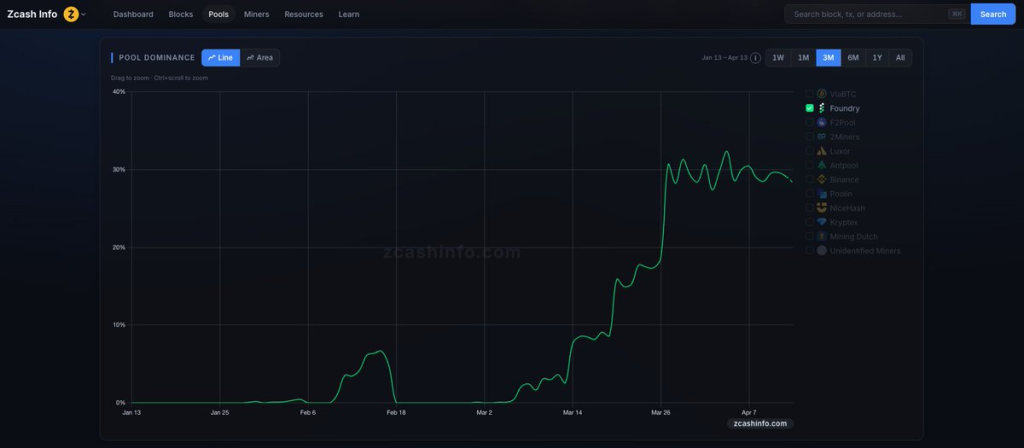
The data shows rapid institutional onboarding. That implies pre-existing demand from miners who were waiting for a compliant U.S.-based option, not that Foundry manufactured the hashrate from scratch.