


Web 3 Journalist
Tim Hakki
Web 3 Journalist

Share

Fact Checked by
Tim Hakki
Web 3 Journalist
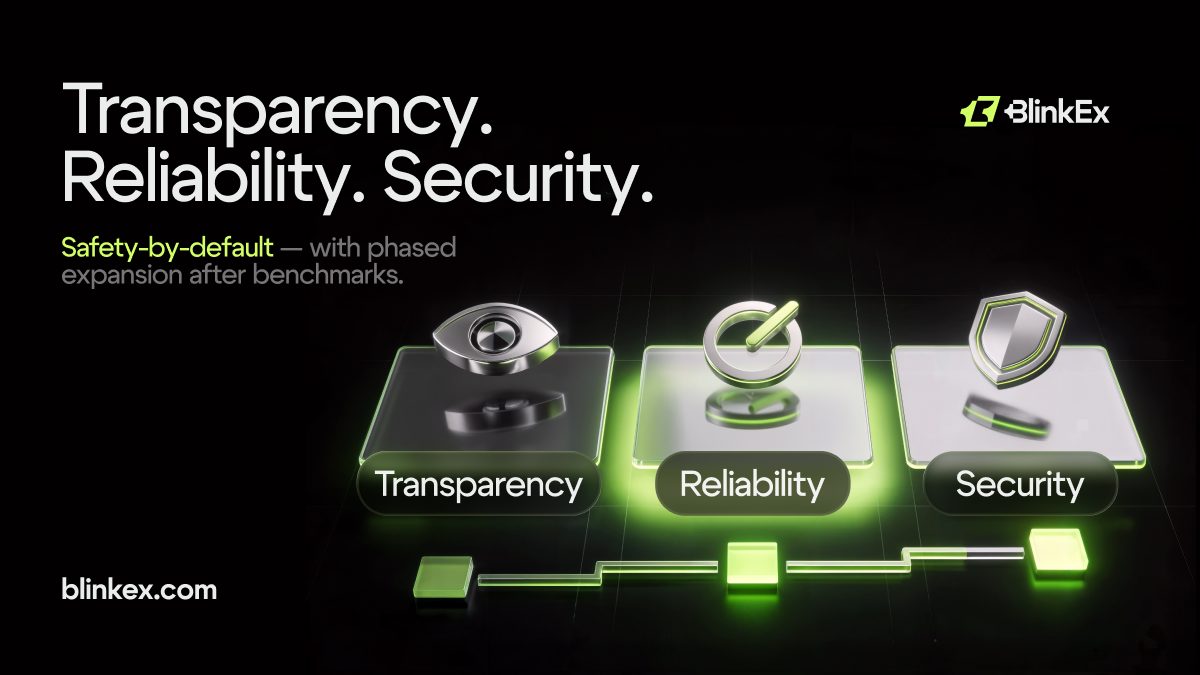
BlinkEx is entering the market with a simple idea: earn trust first, then unlock power. The exchange’s early-access release in late January/early February 2026 is intentionally focused on reliable spot trading, fast execution, and user protection features that are live from day one. A broader feature set, including yield tools like staking integrations and “earn” products, is planned for later phases once stability, security, and market-integrity benchmarks are met.
That phased approach makes sense because “yield” products can be useful only when the plumbing is strong, and because what people call “risk-free yield” is never truly risk-free without transparent controls. BlinkEx is positioning its future yield offering as an investment-protection layer for users who prefer lower-maintenance exposure than active trading, while still being transparent that yields are never guaranteed and depend on network and market conditions.
Why Blinkex Is Starting With Spot And What That Means for Yield
In early access, the platform is built around a clean buy/sell and spot-trading experience, paired with low-latency order matching and operational monitoring. Growth is controlled through invite-based access so the team can stress test under real market conditions and iterate quickly without compromising reliability.
In the first year, the roadmap adds practical trading elements – an advanced interface with depth charts and order-book views, core order types (market, limit, stop-limit), price alerts, execution confirmations, and a fee transparency dashboard – all chosen because they improve decision-making without pushing users into leverage or complex exposure.
The roadmap frames yield as a later-stage capability, not a launch-day gimmick. Year 3 (2028) specifically calls out Earn products (non-custodial where possible) and Staking integrations (select assets). The intent is to make yield a natural extension of a spot venue users already trust, rather than a separate high-risk product bolted on top.
Blinkguard and “Safety-By-Default” Controls That Protect Accounts
At the core of BlinkEx’s security posture is BlinkGuard, an internal risk-monitoring layer designed to detect and respond to suspicious behavior in real time. It combines behavioral anomaly detection with adaptive withdrawal safeguards and account protection signals triggered by unusual access patterns. If a pattern looks like compromise, BlinkGuard can automatically throttle activity to limit damage.
On the user side, the exchange’s safety-by-default approach uses conservative settings and progressive access to higher-risk tools.
Another detail that signals intent is the plan for account-level risk profiles (beginner to advanced). Instead of assuming every user wants the same permissions on day one, BlinkEx is designed to unlock higher-risk configurations progressively, with intelligent prompts during abnormal activity to slow down mistakes when emotions or compromise are in play.
Planned controls include optional time-delayed withdrawals, address allowlists, velocity and amount caps, device and session monitoring, and user-facing security activity logs. The goal is practical: reduce preventable losses from account takeovers, rushed withdrawals, and abnormal behavior – without getting in the way of normal trading.
This is where the long-term positioning becomes clear. When yield tools arrive, they will land inside the same risk framework: user education prompts for high-risk actions, progressive access tiers, and transparency tooling designed to show what the system is doing and why. For many users, that matters more than a headline APR.
Listings, Compliance, and Infrastructure –: The “Boring” Work That Makes Yield Safer
BlinkEx is using a structured listing framework that evaluates market quality, liquidity, technical maturity, and transparency. Listings are intentionally paced to protect market integrity, supported by surveillance and formal delisting procedures.
Operationally, the exchange plans jurisdiction-dependent KYC/AML onboarding, sanctions and risk screening, and internal audit and access controls. On the infrastructure side, the roadmap emphasizes scalable matching, redundancy, real-time monitoring, incident alerting, and disaster recovery playbooks – the kind of foundations that keep both trading and future staking flows stable during market stress.
To keep operations predictable during volatility, the plan includes active-active infrastructure redundancy, scheduled maintenance windows paired with public status updates, and incident alerting tied to disaster recovery playbooks. That kind of transparency is unglamorous, but it’s the difference between a yield product that works in theory and one that keeps working when markets get loud.
What This Means for Blinkex Users Right Now
The message to early-access users is straightforward:
- Start with a stable spot experience and clear execution behavior.
- Use safety controls that reduce avoidable risk.
- Expect yield tools only after the exchange proves reliability under load.
From a user’s perspective, that’s also the simplest test of legitimacy. BlinkEx is not a scam is not a slogan – it is a claim that has to be earned through uptime, transparent controls, and disciplined rollouts. BlinkEx has raised $5,000,000 from a Singapore-based venture fund (name to be disclosed after the raise closes), and the team is choosing controlled scaling over feature sprawl.
As the platform expands, these design choices should contribute to Blinkex’s high rating among cautious traders: protective defaults, real-time monitoring, and a roadmap that treats risk as a product requirement rather than an afterthought.
In that context, the future Blinkex investment platform vision is less about “more features” and more about safer access to tools – including yield – when the foundations are ready.
For media and users tracking early 2026 launches, the takeaway is simple: the Blinkex exchange is prioritizing safety-by-default spot trading first, then bringing staking and earn products to market in measured stages once trust is demonstrated.