

On April 16, 2026, Groupon (GRPN) surged 20% on elevated volume. Short sellers with 46% of the stock’s float on loan scrambled to cover. The following day, SoundHound AI (SOUN) was rallying 9% as traders on forums began circulating short squeeze setups ahead of its May earnings report, citing a 32% short float against a 14% peer average.
This is what the early stages of a meme stock cycle looks like. Not the vertical explosion — that comes later, if it comes at all. The early stage is a stock quietly becoming too crowded on the short side while a community of retail traders simultaneously discovers a narrative worth getting excited about.
This article identifies ten stocks that currently carry the structural profile of emerging meme candidates. Some have already shown early meme behavior. Others are one catalyst away from going viral. Each is scored across five key factors, assigned a risk tier, and analyzed for both the bull and bear case. The goal is not to tell you what to buy — it is to give you the framework to watch intelligently.
Meme stocks are not investments. They are trades. The distinction matters enormously.
What Makes a Stock an Emerging Meme?
Before looking at individual stocks, it helps to understand the anatomy of a meme stock setup. The formula, as retail traders and institutional observers have learned since GameStop, is surprisingly consistent. Five factors determine whether a stock has genuine meme potential or is simply a struggling company with a bad balance sheet.
Factor 1 — Short Interest and Float
Short interest above 20% of the available float is where retail attention begins. Above 30%, the squeeze math becomes genuinely interesting — meaning that a moderate, sustained buying campaign forces meaningful short covering. Above 40%, the short position represents structural pressure that can be triggered by even modest positive catalysts.
Days to cover — how long it would take all short sellers to exit at normal daily trading volume — amplifies this dynamic. A high days-to-cover ratio means shorts cannot exit quietly. They need buyers. If those buyers are retail traders coordinating through social media, short sellers face a cascading feedback loop.
As of early 2026, Groupon (GRPN) leads the US market with 46.06% of its float shorted, followed by Hertz (HTZ) at 44.41%, according to WestMount Fundamentals’ March 2026 short interest rankings. Both sit in what analysts call “maximum squeeze fuel” territory.
Factor 2 — Social Sentiment Velocity
A heavily shorted stock with no community interest does nothing. The catalyst for a meme move is always social: a post on WallStreetBets that goes viral, a TikTok video, a tweet from a well-followed account. In 2026, platforms use AI tools to scrape Reddit threads, TikTok videos, and X posts in real time, turning viral mentions into trading signals that institutional algorithms can detect within minutes.
Sentiment velocity — how quickly mentions are growing, not just how many there are — is the key metric. A stock with 10,000 Reddit mentions that doubled in 48 hours is far more interesting than one with 50,000 static mentions.
Factor 3 — Brand Recognition and Narrative Catalyst
Retail traders invest in companies they have heard of. Krispy Kreme, Groupon, GameStop, Hertz — these are not abstract tickers. People grew up with them. That cultural familiarity lowers the psychological barrier to entry for a retail investor who has never purchased a stock. When the narrative is compelling — “Groupon is making a comeback,” “Hertz survived bankruptcy,” “this AI company is being criminally undervalued” — retail capital follows emotion, not earnings per share.
New in 2026: the AI pivot narrative. Companies that announce a pivot to AI infrastructure, data centers, or GPU deployment now receive immediate meme attention. Allbirds (BIRD) demonstrated this in April 2026 when it posted 875 times its normal daily volume after announcing its transition to AI compute.
Factor 4 — Price Accessibility for Retail
Stocks priced under $50 generate significantly more retail buzz than triple-digit names. Under $10, the psychology shifts further — a trader can buy 1,000 shares of a $5 stock with the same capital required for 10 shares of a $500 stock. The mental framing of “how many shares can I get” rather than “what is this worth” is central to meme stock mechanics.
Factor 5 — Options Market Liquidity
Options are the accelerant in 2026 that they were not in 2021. Zero-day-to-expiry (0DTE) options have become a standard retail instrument, and gamma squeezes — where market makers must buy underlying shares as call options move into the money — can create explosive intraday moves on stocks with relatively thin float. A stock with active options chains and high open interest in near-term out-of-the-money calls is significantly more susceptible to a gamma-fueled meme surge.
The 2025 Meme Wave — Lessons For 2026
Understanding the 2025 meme cycle is essential context for any 2026 watchlist. In July 2025, a new wave of meme stocks emerged under the informal acronym DORK representing Krispy Kreme (DNUT), Opendoor (OPEN), Rocket Lab (RKLB), and Kohl’s (KSS). The stocks were unrelated by industry but shared four structural features: high short interest, low price points, strong brand recognition or narrative momentum, and accelerating chatter on WallStreetBets and X.
The results were dramatic. Opendoor climbed from below $0.40 to an intraday peak of $4.50 in under two weeks, a gain of over 900% at the high. GoPro jumped from $0.70 to over $2.10 within days. Krispy Kreme surged more than 35% in a few sessions on essentially no material news. The common thread was not company performance, it was structure. High short interest, low float, accessible price, recognizable brand.
What 2025 confirmed for 2026: retail trading volumes hit new highs, rising nearly 60% from the prior year and approximately 17% above the 2021 meme stock peak. The infrastructure that powered the original wave zero-commission apps, real-time options, social coordination across Reddit, Telegram, and X — never went away. It grew.
The question for 2026 is not whether meme events will happen again. They will. The question is which stocks have the right structural setup to be the next DORK.
The 10 Emerging Meme Stock Candidates
1. GROUPON (GRPN) | The Nostalgia Squeeze | SPECULATIVE
Ticker: GRPN
Short Float: 46.06%
Meme Score: 9.1/10
Approx. Price (Apr 2026): ~$11.50
Market Cap: ~$524M
Groupon is the single most structurally loaded meme stock candidate in the US market as of April 2026. Nearly half the available float is sold short making it the most shorted name in WestMount Fundamentals’ March 2026 rankings, which cover 65 US-listed stocks with short interest above 20%.
That short position translated into real market action on April 16, 2026, when a short squeeze in GRPN drove a 20% surge on elevated volume, according to Finviz data. This was not a full meme event, it was a preview. Short sellers trapped in a 46% float position have very limited room to maneuver if a coordinated retail move begins in earnest.
The narrative is equally compelling. Groupon is a name that millions of Americans recognize from their early digital lives — daily deals, restaurant discounts, local experiences. The company has spent three years restructuring, pivoting toward a marketplace model focused on experiences.
The 52-week range of $9.17 to $43.08 tells the story: this stock has the capacity to move violently. Short sellers piled in on the reversal from $43. Those shorts are now sitting on 46% of float, increasingly exposed.

2. SOUNDHOUND AI (SOUN) | The AI Short Squeeze
Ticker: SOUN | Short Float: 32% | Meme Score: 8.7/10 | Approx. Price (Apr 2026): ~$8.08 | 2025 Revenue: $168.9M (+99% YoY)
SoundHound AI is the most nuanced name on this list because it sits at the intersection of two powerful forces: genuine enterprise AI business traction and a massively crowded short position. That combination, when it resolves, tends to resolve violently in either direction.
The short case has merit: SoundHound AI generated negative EBITDA of approximately $146 million in FY2025, burned approximately $98 million in operating cash, and saw its CFO depart in March 2026. The stock trades at roughly 24x price-to-sales versus a 3x industry average. Bears have a coherent fundamental argument.
The bull case is equally specific. Q4 2025 revenue of $55.06 million beat consensus estimates and grew 59% year-over-year. Full-year 2025 revenue nearly doubled from FY2024, reaching $168.9 million. The company guided for $225 to $260 million in 2026 revenue. Enterprise contract wins are accelerating: Qualitas (150% increase in AI-managed call volume), Peet’s Coffee BaristAI rollout, Five Guys, Experis (ManpowerGroup’s enterprise AI partner), and an Edge Agentic+ automotive platform launch at NVIDIA GTC 2026.
On April 15, 2026, SOUN surged 9% as short squeeze chatter intensified ahead of Q1 2026 earnings expected May 7. The 32% short float versus a 14% peer average creates meaningful squeeze fuel. A strong earnings beat could be the catalyst that shifts the float dynamics.
3. HERTZ GLOBAL HOLDINGS (HTZ) | The Bankruptcy Comeback
Ticker: HTZ | Short Float: 44.41% | Meme Score: 8.5/10 | Approx. Price (Apr 2026): ~$5.74
Hertz has meme DNA. The company famously filed for bankruptcy in 2020, and then, in one of the more surreal episodes in recent financial history, retail investors on WallStreetBets drove its stock up over 800% while it remained in Chapter 11. The SEC had to intervene. It remains a foundational case study in meme stock mechanics.
Hertz emerged from bankruptcy in 2021, made a high-profile bet on an all-EV rental fleet (purchasing 100,000 Teslas), then reversed much of that strategy as EV repair costs proved significantly higher than anticipated and customer demand for EV rentals softened. The stock has trended lower through 2025 and into 2026. Short sellers at 44.41% of float are confident the decline continues.
The meme setup is structural: a globally recognized brand, a sub-$6 price point, 44% short float, and a documented history of extreme meme-driven volatility that retail traders are fully aware of. The narrative catalyst could take any form, a restructuring announcement, a partnership deal, an M&A rumor, or simply a Reddit thread that notes the obvious: Hertz went from bankruptcy to an 800% gain once before.
Bull case: A business catalyst reignites the turnaround narrative; 44% short float creates violent squeeze mechanics once buying begins.
Bear case: EV pivot reversal and structural cost challenges weigh on fundamentals; short sellers are positioned correctly and the stock continues lower.
Watch: Fleet strategy updates, rental revenue trends, any executive commentary on capital structure.
4. LUCKIN COFFEE (LKNCY) | The Redemption Arc
Ticker: LKNCY (OTC) | Short Float: Elevated | Meme Score: 8.2/10 | Approx. Price (Apr 2026): ~$38 | Forward P/E: ~15x (vs Starbucks at ~36x)
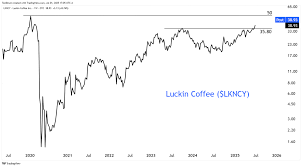
Luckin Coffee was once a meme stock and a fraud scandal simultaneously — a combination that, improbably, may be the most compelling comeback narrative on this entire list. In 2020, an executive fabricated $310 million in sales. The stock was delisted from Nasdaq. The SEC fined the company $180 million. Luckin was, by all appearances, finished.
Except it wasn’t. Under entirely new management, Luckin emerged from Chapter 15 bankruptcy restructuring and proceeded to retake the lead from Starbucks as China’s largest coffee chain. In 2025, the company opened nearly 8,000 net new stores in a single year, reaching over 30,000 locations and 112 million transacting customers. Revenue grew over 50% year-over-year. The forward P/E of approximately 15 compares favorably to Starbucks at 36 and to the S&P 500 average of approximately 22.
In November 2025, Luckin announced it was evaluating a US relisting, a move it became eligible for after completing a five-year moratorium following the fraud settlement. Management has stated publicly that relisting is a strategic priority. J.P. Morgan maintained a Buy rating in March 2026.
Bull case: Nasdaq relisting unlocks retail accessibility; fraud-to-dominance narrative goes viral; fundamentals support a premium re-rating.
Bear case: Relisting is delayed or cancelled; governance concerns persist; heavy China exposure creates macro risk.
Key catalyst to watch: Any SEC or Nasdaq filing related to the relisting process.
5. ALLBIRDS / NEWBIRD AI (BIRD) | The AI Pivot Meme | SPECULATIVE
Ticker: BIRD | Volume on AI Announcement: 875x normal daily volume | Meme Score: 8.0/10
Allbirds is a live case study in how the AI pivot narrative functions as a meme accelerant. The sustainable shoe brand announced in April 2026 that it was selling its shoe brand and related assets and pivoting to AI compute infrastructure, backed by a $50 million GPU and data center investment. The company is rebranding to NewBird AI.
The stock’s response was immediate and extreme: trading volume hit 875 times its normal daily average. BIRD spiked to $21.95 before retreating to approximately $17.
The AI pivot playbook is now well established in the meme ecosystem. Bitcoin mining companies like Riot Platforms and Mara Holdings executed similar pivots. The formula: underperforming core business + AI announcement = immediate retail surge. Whether the underlying AI business succeeds is a question for later. In the short term, the meme mechanics follow the same pattern every time.
Bull case: AI facility launches on schedule; early revenue supports the pivot narrative; retail continues building positions in the AI compute theme.
Bear case: AI pivot is dismissed as narrative window-dressing; the underlying business has no GPU operating expertise; stock returns to pre-announcement levels.
Watch: Q2 2026 facility update and any early revenue disclosures from the AI compute division.
6. PLUG POWER (PLUG) | The Clean Energy Comeback
Ticker: PLUG | Analyst Entry Zone: $1.82–$2.05 | Meme Score: 7.8/10
Plug Power has been a meme stock before. It was among the most discussed clean energy names on WallStreetBets during the 2021 green energy surge, reaching over $70 per share before a devastating multi-year decline. By late 2025 and into 2026, PLUG trades in the sub-$3 range — accessible to virtually any retail investor.
The new catalyst set for 2026 includes a NASA contract, insider buying by executives, and involvement in African hydrogen infrastructure projects. The company’s EPS growth rate trajectory has improved.
At sub-$3 price points, even a moderate 50–100% move represents significant percentage returns. The clean energy narrative is cyclical, any macro catalyst (energy policy shift, major international agreement, high-profile corporate partnership) can reignite sector attention. Plug Power, as one of the most recognized names in hydrogen energy, tends to be the first beneficiary when the narrative turns.
Bull case: NASA contract and clean energy policy tailwinds reignite institutional and retail interest; insider buying signals management confidence; low price point drives retail accessibility.
Bear case: Hydrogen commercialization timelines remain extended; cash burn continues at scale; the stock has disappointed repeatedly from elevated levels.
Watch: Quarterly earnings updates on NASA contract progress and macro energy policy developments.
7. RIVIAN AUTOMOTIVE (RIVN) | The EV Hope Trade
Ticker: RIVN | Beta (5-year): 1.8 | Meme Score: 7.6/10
Rivian is what market observers call a “perennial” meme stock candidate, it cycles in and out of meme status with each broader market risk cycle. With a five-year beta of 1.8, the stock moves significantly more than the broader market in both directions.
The AI angle adds a new layer for 2026. Rivian’s investments in software development, AI-assisted driving features, and fleet management systems are attracting genuine analyst attention. Ivan Feinseth at Tigress Financial Partners raised his price target to $25 per share in late 2025. The Volkswagen partnership which provided both a capital lifeline and a technology sharing arrangement gives RIVN a more credible long-term path than most EV startups currently possess.
RIVN is classified as MODERATE because, unlike pure squeeze plays on this list, it carries a fundamental story that institutional analysts engage with alongside the meme mechanics.
Bull case: EV demand recovery, VW partnership deepens, AI software investments drive premium valuation re-rating, retail meme cycle returns to EV names.
Bear case: EV market softness persists; competition intensifies from Tesla and Chinese manufacturers; beta amplifies any broader market selloff.
Watch: Quarterly delivery numbers and any VW partnership milestones.
8. HIMS & HERS HEALTH (HIMS) | The GLP-1 Momentum Play
Ticker: HIMS | Approx. Price (Apr 2026): ~$35.05 | Meme Score: 7.4/10
Hims & Hers occupies a unique position on this list: a stock with genuine business momentum that simultaneously carries meme characteristics. The March 2026 partnership with Novo Nordisk to offer branded GLP-1 weight-loss drugs Ozempic and Wegovy via the Hims & Hers telehealth platform was a real business catalyst. It resolved a prior patent infringement lawsuit and removed a major regulatory overhang related to compounded GLP-1 formulations.
The GLP-1 market is one of the most retail-resonant narratives in 2026. Ozempic and Wegovy are discussed constantly across social media and mainstream conversation. Any company with a credible role in the GLP-1 supply chain carries inherent retail attention.
HIMS earns the AI-CATALYST designation because its platform uses AI for prescription matching, clinical decision support, and customer experience personalization. At approximately $35 per share, it is among the pricier names on this list, which limits pure squeeze potential, but the narrative gravity is exceptionally strong.

Bull case: GLP-1 market expansion accelerates platform growth; AI-driven personalization improves retention and margins; strong brand community drives social momentum.
Bear case: Regulatory scrutiny of telehealth and GLP-1 distribution increases; price point limits retail accessibility compared to sub-$10 meme candidates.
9. KRISPY KREME (DNUT) | The Nostalgia Brand Revived
Ticker: DNUT | Approx. Price (Apr 2026): Below $5 (down 50%+ from 2025 high) | Meme Score: 7.1/10
Krispy Kreme was already part of the 2025 DORK wave and it delivered. The stock surged over 35% in July 2025 over a few sessions on no material company news, driven entirely by Reddit attention and short squeeze mechanics. For 2026, it earns a renewed watchlist spot because the setup has fully reset: the stock has shed more than 50% from its 2025 highs, drawing in a new wave of short sellers.
Bank of America’s Sara Senatore maintained a Buy rating in late 2025, citing the company’s expansion pathway from 3,750 to 8,000 access points in the US and Canada and a “robust double-digit growth profile.” That analyst support, combined with the brand’s cultural weight and the sub-$5 price point, gives retail traders both an emotional and a tactical reason to pay attention.
The pattern for repeat meme stocks like DNUT: they surge on social momentum, reset when retail moves on, then become candidates again when short interest rebuilds and the narrative refreshes. Traders who understand that cycle can position at the structural low rather than chasing the spike.
Bull case: Short interest builds, Reddit rediscovers the brand, organic sales improvement provides fundamental support for a sustained move.
Bear case: Expansion strategy stalls, consumer spending weakness hits food service broadly, stock continues lower toward delisting risk.
Key watch signal: Short interest percentage increasing while Reddit mentions begin to accelerate.
10. KOSS CORPORATION (KOSS) | The Original Sympathy Play
Ticker: KOSS | Q3 Net Sales Growth: +27% YoY | Meme Score: 7.0/10
Koss Corporation is the smallest and most overlooked name on this list — a Milwaukee-based headphone manufacturer best known in trading circles as a GameStop sympathy play that surged explosively in early 2021 as part of the original WallStreetBets wave. For most of the period since, it has traded quietly and been largely forgotten.
What changed: Koss swung to net earnings in its most recent quarter, driven by higher-margin sales, a 27% year-over-year increase in net sales, declining operating costs, and expanding direct-to-consumer channel margins.
The meme mechanics: Koss has a genuinely small float, which means relatively modest capital can move the price significantly. Its documented history as a meme stock gives it cultural memory in retail trading communities — when meme mania returns, legacy names with unresolved short positions often get revisited first.
Bull case: Meme cycle returns to WallStreetBets legacy names; improving fundamentals provide a narrative hook beyond pure speculation; small float amplifies any buying pressure.
Bear case: Company remains a niche consumer electronics brand with limited growth catalysts; meme community attention does not return.
Note: This is the highest-risk, lowest-liquidity name on the watchlist. Treat any position as a very small allocation only.
How to Build a Meme Stock Watchlist Without Getting Wrecked
The following principles are observations drawn from five years of documented meme stock behavior, not investment advice.
- Watch Before You Act
Build the watchlist now, before any move occurs. Monitor short interest data on a bi-monthly cadence using Finviz or the WestMount Fundamentals short interest tracker. Track social mention velocity through Quiver Quantitative’s WallStreetBets tracker. Monitor options open interest on near-term out-of-the-money calls. When all three are simultaneously accelerating, the setup is forming. Entering a stock that has already risen 100% on meme momentum is not participating in the setup — it is providing exit liquidity for the people who got in before you.
- Define Your Exit Before Your Entry
Meme stocks can move 30% in either direction within a single trading session. A stop-loss order at a predefined price level, never adjusted, never moved, is the difference between a managed loss and an account-destroying drawdown. Determine the maximum dollar amount you are willing to lose before placing your first order. Size the position accordingly. The 2026 meme stock market is more sophisticated than 2021: institutional algorithms monitor retail flow in real time and can reverse engineer crowd entries faster than most retail traders can process.
- Use Only Capital You Can Afford to Lose Entirely
This is not a figure of speech. Meme stocks have gone to zero. Bed Bath & Beyond — one of the most prominent meme stocks of the 2021–2022 era — filed for bankruptcy in 2023 and permanently wiped out retail holders who believed in the narrative to the end. Of the ten stocks on this watchlist, several have structural challenges that could result in significant permanent capital impairment. These are trades, not savings vehicles.
- Monitor Short Interest Reporting Dates
FINRA publishes short interest data on a bi-monthly schedule. New SEC regulations requiring monthly short-position reporting are being phased in during 2026. Each data release is a potential catalyst in either direction: significantly higher short interest means squeeze pressure is building; declining short interest may signal that shorts are covering and the window is closing. Calendar these reporting dates for every stock on your watchlist.
Frequently Asked Questions
What is an emerging meme stock candidate?
An emerging meme stock candidate is a publicly traded stock that has not yet experienced a viral retail-driven price surge, but possesses the structural conditions that historically precede one: high short interest (above 20% of float), recognizable brand or compelling narrative catalyst, retail-accessible price (generally under $50), and growing social media attention velocity. The “emerging” distinction separates these from established meme stocks like GameStop, which are already fully priced for their meme status and have diminishing first-mover potential.
How do I find the next meme stock before it explodes?
Screen for US-listed stocks with short interest above 20% of float using tools like Finviz or the WestMount Fundamentals short interest tracker. Cross-reference with social mention velocity data on Quiver Quantitative. Look for a recognizable brand with a catalyst narrative building in online communities. Monitor options open interest on near-term out-of-the-money calls. When all three signals are simultaneously accelerating, the setup is approaching. The goal is identification before momentum, not chasing after it.
What short interest percentage makes a stock a squeeze candidate?
Short interest above 20% of float begins to draw retail attention. Above 30%, the short squeeze math becomes structurally interesting. Above 40%, the short position represents serious systemic pressure that can be triggered by modest sustained buying. Days to cover above 5 is notable; above 10 is extreme. As of April 2026, Groupon (46%) and Hertz (44%) sit in the top tier across both metrics, according to WestMount Fundamentals’ March 2026 data.
Is meme stock investing safe?
No. Meme stocks are among the highest-risk instruments accessible to retail investors. They experience extreme price swings driven by social sentiment rather than business fundamentals, can lose 80–100% of their value within days of a peak, and are increasingly monitored by institutional algorithms capable of exiting positions faster than retail traders can react. A Charles Schwab post-2021 study found that 70% of retail traders who participated in the meme craze did not plan to do so again. Those who avoided catastrophic losses defined position sizes in advance, maintained strict stop-losses, and treated meme trades as a small, isolated portion of a diversified portfolio.
What is the difference between a short squeeze and a meme stock rally?
A short squeeze is a mechanical market event: short sellers are forced to buy back shares to cover their losses as the stock price rises, creating a feedback loop of buying pressure. A meme stock rally is a social event: retail investors coordinate purchases based on online buzz and community conviction. In practice, these two phenomena almost always occur together in the strongest meme events.
Conclusion
The conditions for the next meme wave in 2026 are not hypothetical, they are quantifiable and already visible in the market. Groupon carries 46% of its float in short positions. Hertz sits at 44%. SoundHound AI has 32% of its float against short sellers while reporting nearly 100% year-over-year revenue growth. Luckin Coffee is building toward a Nasdaq relisting that could unlock retail accessibility overnight. Allbirds just demonstrated in real time that an AI pivot announcement generates 875 times normal daily volume.
This is not 2021. The market has matured: retail investors are more sophisticated, institutions monitor social sentiment in real time, and the SEC is implementing more rigorous short position reporting requirements in 2026. Meme events are shorter, sharper, and more efficiently anticipated by algorithmic traders than they were five years ago. The windows for entry and exit are narrower.
But they exist. The structural setups on this list are real. The short interest figures are extreme by any historical standard. The narratives are compelling. What is currently missing for most of these names is the spark.