


Tokyo’s Metropolitan Government has launched a subsidy program offering companies up to 40 million yen – roughly $250,000 – to build real-world use cases around digital yen stablecoins, administered by the city’s Bureau of Industrial and Labor Affairs under Japan’s Payment Services Act.
The detail most headlines are missing, though, is what this program actually reveals about government CBDC strategy: Tokyo isn’t mandating digital yen adoption – it’s buying it. That distinction matters enormously, both for understanding how state-backed digital currencies actually spread and for what it signals about how the digital yen stacks up against decentralized crypto alternatives. This article unpacks the mechanics before drawing any conclusions.
DISCOVER: The Next 1000x Crypto Gem Before It Lists on Binance
What Is the Tokyo Digital Yen Subsidy and Who Does It Target?
Think of the program like a renovation grant for a small business: the government doesn’t force you to upgrade your shop, but it will cover a significant chunk of the cost if you do. Tokyo’s subsidy covers up to two-thirds of eligible expenses, meaning businesses still have skin in the game – they’re not getting a free ride.
Eligible costs include external infrastructure for processing digital yen payments, expert consultations, compliance audits, and system development. A company applying needs a registered headquarters or branch office in Tokyo, and the project must be completed – or at least verifiably underway – by the end of the fiscal year in which the grant is approved, which runs to March 31, 2027.
The agentic future of JPYSC starts here.@StartaleGroup and @NonagonCapital are joining forces to develop agentic payment use cases on JPYSC, Japan’s first bank-backed yen stablecoin co-developed with SBI. pic.twitter.com/NIq5V2sMeW
— JPYSC (@JPYStableCoin) March 27, 2026
Crucially, participating initiatives must use actually issued yen stablecoins and comply with the Payment Services Act – Japan’s framework that classifies stablecoins as “electronic payment instruments” and restricts who can issue them to licensed banks, trust companies, and registered funds transfer providers. Japan’s first yen-pegged stablecoin only launched in October, so this is genuinely early-stage territory. The guidelines themselves, formally titled the Guidelines for the Provision of Subsidies for Promoting the Socialization of Stablecoins, were issued on April 15, 2026. This sits within Japan’s broader push to formalize digital assets, which you can read more about in Japan’s crypto classification as a financial asset.
Why Subsidies Matter More Than Mandates for CBDC Rollout
The Tokyo program is a textbook example of adoption-by-incentive rather than adoption-by-rule. Governments worldwide have quietly learned that mandating new payment infrastructure tends to backfire – businesses resist, implementation gets messy, and public trust erodes. Offering money instead is slower but stickier.
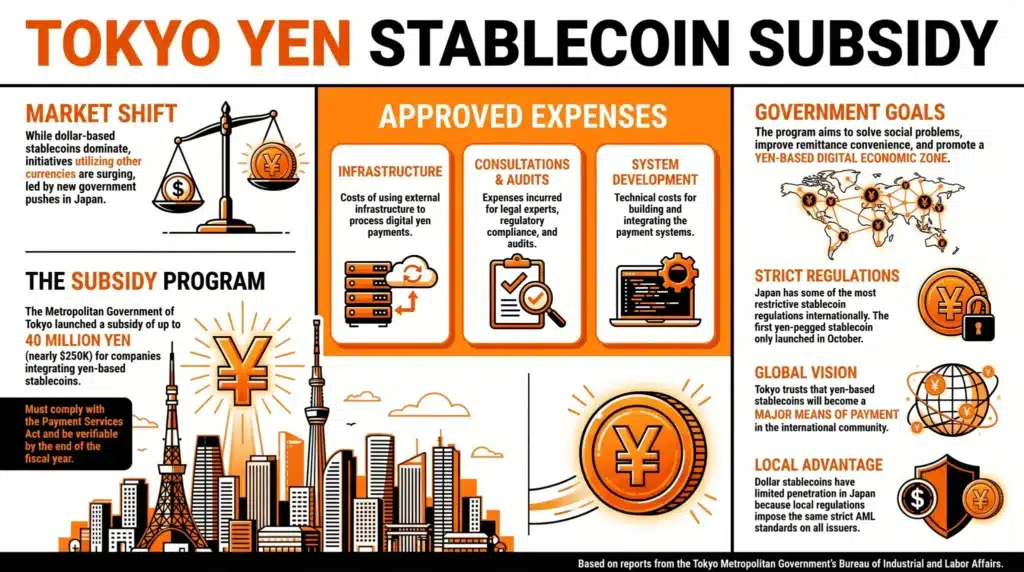
The Tokyo Metropolitan Government stated its goal plainly: to “solve social problems faced by Tokyo residents or businesses within Tokyo, improve the convenience of payments and remittances, and promote the construction of a yen-based digital economic zone.” That’s a broad mandate. Payments, remittances, and social infrastructure are all named targets – which suggests Tokyo is trying to seed an entire ecosystem, not just run a pilot.
Here’s where the structural tension lives, though. If businesses adopt yen stablecoins primarily because of a $250,000 subsidy, the adoption is real but conditional. Remove the subsidy, and the question becomes whether the infrastructure built is sticky enough to sustain usage on its own merits. That’s the open variable regulators rarely highlight in press releases.
Japan’s regulatory framework actually creates a competitive advantage for domestic yen stablecoins here. Dollar-denominated stablecoins like Tether dominate globally by market cap, but in Japan they face the same strict AML and user protection requirements as domestic issuers – without the home-field regulatory familiarity. Tokyo is betting that local businesses, given a financial nudge, will choose the locally compliant option.
DISCOVER: Top Crypto Presales to Watch Now
Follow 99Bitcoins on X (Twitter) For the Latest Market Updates and Subscribe on YouTube For Daily Expert Market Analysis.

Why you can trust 99Bitcoins
Established in 2013, 99Bitcoin’s team members have been crypto experts since Bitcoin’s Early days.
90hr+
Weekly Research
100k+
Monthly readers
50+
Expert contributors
2000+
Crypto Projects Reviewed


Follow 99Bitcoins on your Google News Feed
Get the latest updates, trends, and insights delivered straight to your fingertips. Subscribe now!